Loudoun County Court serves as the foundation of the local judicial process and handles a wide range of legal matters within the county. The court system Loudoun County residents rely on covers civil disputes, criminal charges, family-related cases, and probate matters. It operates as part of the broader Virginia courts structure and applies state laws at the county level. Many people search for Loudoun County courts to find case details, court locations, filing procedures, or clerk information. This local judicial system supports fair case handling and public court access.
Loudoun County Court plays a central role in resolving legal issues that affect daily life across the county. The Loudoun County legal system includes multiple courts, each assigned to specific case types and legal responsibilities. These county-level courts in Virginia manage hearings, filings, and official records for residents and legal professionals. Searches related to Loudoun County courts often focus on court records, case status, or knowing where to file a legal matter. Clear structure and defined roles help the courts serve the community efficiently.

How to Access Loudoun County Court Records
Loudoun County court records can be searched online through the official Virginia Judicial System case search portal or requested directly from the courthouse clerk. Availability depends on case type, court level, and privacy restrictions set by Virginia law.
For residents, attorneys, or researchers, accessing Loudoun County court records is often necessary to verify filings, check case progress, or review public outcomes. The county provides both online case lookup tools and in-person request options for records not posted digitally.
Online Court Record Search Options
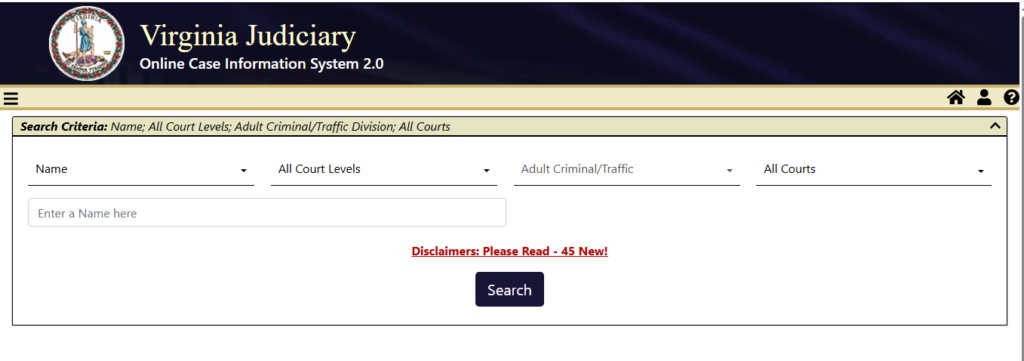
Online search is the fastest way to view Loudoun County court records. Virginia courts maintain a statewide case search portal that covers Circuit, General District, and Juvenile & Domestic Relations Courts. Users can access basic case information without logging in or paying fees.
Official site for case lookup: https://www.vacourts.gov/caseinfo/home.html
Step to Search Online:
- Open the official portal – Visit https://www.vacourts.gov/caseinfo/home.html.
- Select the court division – Choose from Circuit Court, General District Court, or Juvenile & Domestic Relations Court depending on the case type.
- Choose your search method:
- By Name: Enter the first and last name of a party involved. Adding middle initials improves accuracy.
- By Case Number: Input the exact case number for precise results.
- By Hearing Date: Specify the date the case appeared in court.
- Click “Search” – The portal displays matching cases, including basic information like case type, parties, and hearing dates.
- View detailed case information:
- Case docket – Lists filings, motions, and hearing schedules.
- Case status – Shows if the case is active or closed.
- Judge assignments – Identifies the presiding judge and courtroom.
- Filter results if needed – Narrow results by court type or date ranges.
In-Person Court Record Requests
Some court documents are not available online. For older files, certified copies, or restricted filings, visiting the courthouse is necessary.
Steps In-Person Request Guide:
- Locate the correct Clerk’s Office:
- Circuit Court Clerk – Handles felony cases, major civil cases, and probate matters.
- General District Court Clerk – Handles misdemeanors, traffic cases, and small claims.
- Juvenile & Domestic Relations Clerk – Handles family law and youth cases.
- Bring required documents:
- Valid government-issued ID
- Case number or full party name
- Completed request form (available at the clerk’s office)
- Submit your request – Provide staff with details of the case you want.
- Pay applicable fees:
- Standard copies: ~$0.50 per page
- Certified copies: ~$2 per document
- Receive records – Some files may require same-day processing; others may take a few business days depending on size or complexity.
Records typically requiring in-person access:
- Archived case files
- Court exhibits or attachments
- Certified or notarized copies
- Files with privacy restrictions
Record Availability & Privacy Restrictions
Virginia law places limits on public access to certain court records to protect privacy. Understanding these restrictions helps users know what is available online versus in-person.
Restricted Records Include:
- Sealed records – Closed by court order (e.g., adoption or sensitive civil cases).
- Confidential court files – Ongoing investigations or sensitive matters.
- Juvenile records – Generally inaccessible to the public.
- Mental health commitment cases – Restricted by law.
Types of Courts in Loudoun County
Loudoun County is served by several courts, each handling specific types of cases. Residents rely on these courts for civil, criminal, family, and federal matters depending on the nature of the dispute.
Circuit Court
Loudoun County Circuit Court is the primary trial court for major civil and criminal cases in the county. It handles cases beyond the scope of district courts, including serious criminal offenses and large civil disputes.
The circuit court in Loudoun County has broad authority across civil, criminal, probate, and family law matters. Felony trials are conducted here, along with divorce and child custody disputes. Probate matters, such as wills and estate administration, also fall under its jurisdiction. Additionally, the court hears appeals from district courts, giving residents a higher level of judicial review.
Key functions of Loudoun County Circuit Court include:
- Jurisdiction thresholds: Handles civil cases exceeding $25,000 and criminal cases classified as felonies.
- Civil authority: Resolves contract disputes, personal injury claims, and property litigation.
- Criminal authority: Conducts jury trials for serious criminal charges.
- Family law: Manages divorce proceedings, custody battles, and support disputes.
- Probate jurisdiction: Oversees estate administration, guardianships, and wills.
- Appeals: Considers appeals from General District and Juvenile & Domestic Relations courts.
General District Court
The Loudoun County General District Court handles cases with limited monetary or criminal thresholds. This court is where misdemeanor offenses, traffic violations, and small claims are processed quickly and efficiently.
Unlike the circuit court, district courts in Loudoun County do not conduct jury trials. Judges decide cases, including civil disputes under $25,000 and minor criminal matters. This court is also the first stop for preliminary hearings in felony cases, providing an initial assessment before cases may move to the circuit court.
Important aspects of the General District Court include:
- Traffic violations: Tickets, speeding cases, and other motor vehicle infractions.
- Misdemeanor court: Low-level criminal offenses such as petty theft or disorderly conduct.
- Civil limits: Small claims and disputes under $25,000.
- Eviction cases: Residential and commercial landlord-tenant disputes.
- Preliminary hearings: Early stage reviews for felony charges.
Juvenile and Domestic Relations Court
The Loudoun County Juvenile and Domestic Relations Court focuses on cases involving minors and family matters. This specialized court handles sensitive issues with privacy and legal protections for children and families.
Family and juvenile matters in this court include:
- Child custody court: Resolves custody and visitation disagreements between parents.
- Juvenile delinquency: Cases involving minors accused of criminal activity.
- Child support hearings: Establishes financial responsibilities for children.
- Protective orders: Responds to abuse, neglect, or domestic violence complaints.
Coverage includes:
- Family disputes, including custody, support, and visitation.
- Juvenile offenses, including delinquency and status offenses.
- Protective and restraining orders in domestic cases.
Federal Court Serving
Residents of Loudoun County also fall under the jurisdiction of the United States District Court for the Eastern District of Virginia. This federal court addresses cases governed by national law, including constitutional, criminal, and civil matters.The court operates in the Alexandria Division, serving multiple Northern Virginia counties, including Loudoun. Federal jurisdiction applies when cases involve federal statutes, interstate disputes, or parties from different states.
Key points about the federal court include:
- Federal cases: Include bankruptcy, federal criminal charges, civil rights disputes, and patent matters.
- Geographic coverage: Handles cases from Loudoun, Fairfax, Arlington, and surrounding areas.
- Difference from state courts: Federal courts follow federal law rather than Virginia state law.
Loudoun County Clerk of Court Offices
The Loudoun County Clerk of Court Offices manage essential court records and ensure that legal documents are properly filed and maintained. These offices play a key role in both the Circuit and District Courts, offering services from probate record management to court filing processing.
Clerk of the Circuit Court
The Loudoun County Clerk of Circuit Court is responsible for managing official records and providing administrative support to the Circuit Court. This office handles a wide range of legal documents, including probate records, marriage licenses, land records, and other court filings.
The Circuit Court Clerk serves as the custodian of records for civil, criminal, and family cases. Responsibilities include issuing marriage licenses, recording deeds and land transactions, managing probate and estate cases, and maintaining all official court documents. Clerks also coordinate with judges and court staff to ensure smooth court proceedings.
Key duties include:
- Managing and maintaining official court filings and documents
- Supervising probate matters, including wills and estate administration
- Issuing marriage licenses and maintaining accurate civil records
- Recording and preserving land and property records
The Clerk of Circuit Court is an elected official, typically serving a term of four years. The current Clerk oversees staff, implements office policies, and ensures compliance with Virginia state laws. This office provides public access to records for research, legal purposes, and transactions, while safeguarding sensitive information.
Role and Authority: The Circuit Court Clerk acts as a legal administrator, balancing responsibilities between public service and compliance with state regulations. This position has authority to authenticate documents, maintain court archives, and manage procedural requirements.
Clerk of the District Court
The Loudoun County District Court Clerk manages administrative functions specific to the District Court system. Unlike the Circuit Court Clerk, this office focuses on lower court matters such as traffic violations, misdemeanor offenses, and small civil cases.
District Court Clerks handle court record maintenance, filing processing, and general court administration. They ensure that all filings comply with legal standards and that case information is accurate and organized for judges and staff. Each type of court has a separate clerk, which helps streamline operations and prevent confusion between circuit and district matters.
Key differences between Circuit and District Court Clerks:
- Circuit Court Clerks handle major civil, probate, and family cases, while District Court Clerks manage minor criminal and civil matters.
- Circuit Court Clerks maintain long-term property and probate records; District Court Clerks focus on timely filing and court scheduling.
- Each office operates independently but coordinates for cases that may escalate from District to Circuit Court.
Civil vs Criminal Cases in Loudoun County Courts
Civil and criminal cases in Loudoun County courts serve different purposes and follow distinct procedures. Civil courts handle disputes between individuals or organizations, while criminal courts deal with offenses against the state or public safety.
Case Type Comparison: Civil vs Criminal
Loudoun County civil court focuses on resolving disagreements between parties. These disputes often involve contracts, property issues, family matters, or personal injury claims. The goal is usually compensation or a court order rather than punishment. Cases in civil court typically involve civil disputes where the plaintiff seeks damages or legal remedies.
Loudoun County criminal court addresses actions considered harmful to society. Cases range from misdemeanor offenses, like petty theft or minor traffic violations, to felony cases involving serious crimes such as assault or burglary. Criminal court proceedings aim to determine guilt and impose appropriate court sentencing, which can include fines, probation, or imprisonment.
| Feature | Civil Cases | Criminal Cases |
|---|---|---|
| Purpose | Resolve disputes between parties | Enforce laws and punish offenders |
| Examples | Contract disputes, property claims, divorce | Theft, assault, DUI, murder |
| Burden of Proof | Preponderance of the evidence | Beyond a reasonable doubt |
| Outcome | Monetary damages or injunctions | Fines, probation, imprisonment |
| Court Type | Loudoun County civil court | Loudoun County criminal court |
Key Differences in Procedure
Civil cases often begin when a plaintiff files a complaint and seeks a remedy from the defendant. Hearings and trials in civil court focus on evidence, documents, and witness testimony to establish responsibility. Judges or juries evaluate claims and determine compensation or other legal actions.
Criminal cases usually start with an arrest or indictment. Prosecutors represent the state, and defendants are entitled to legal representation. Trials examine the facts to establish guilt. Court sentencing follows a conviction, with penalties reflecting the severity of the felony case or misdemeanor offense.
Magistrates in Loudoun County
Loudoun County magistrates are judicial officers who handle urgent legal matters, including issuing arrest warrants, conducting bail hearings, and approving emergency custody orders. They act as an accessible point of the court system, providing essential services outside regular court hours.
Authority of Loudoun County Magistrates
Magistrates in Loudoun County hold the authority to make immediate legal decisions in criminal and civil matters that require prompt attention. Their responsibilities include evaluating requests for arrest warrants, determining bail amounts during bail hearings, and issuing emergency custody orders when necessary. This authority allows law enforcement and the public to act quickly in situations that cannot wait for a formal court proceeding.
Eligibility and Qualifications
To serve as a magistrate, individuals must meet specific eligibility and qualification requirements. Typically, candidates need a background in law enforcement or legal studies, experience in courtroom procedures, and the ability to make unbiased decisions under pressure. Magistrates are appointed by the state and must demonstrate knowledge of Virginia law and local regulations.
Key Responsibilities
Loudoun County magistrates manage urgent legal matters, including:
- Issuing arrest and search warrants based on probable cause
- Conducting bail hearings and setting appropriate bond amounts
- Authorizing emergency custody orders to protect public safety
- Handling urgent civil matters when the circuit or district courts are unavailable
Specialized Courts in Loudoun County
Loudoun County offers specialized courts to address unique needs of certain offenders, focusing on rehabilitation and community reintegration. These courts provide structured programs that reduce recidivism and support participants through targeted assistance.
Veterans Treatment Court
Loudoun County Veterans Court serves military veterans who face legal challenges related to service-connected issues. This court provides a structured environment that helps veterans address underlying problems, such as substance use or mental health concerns, while remaining accountable to the legal system.
The program operates as a veteran diversion program, meaning eligible participants may have criminal charges adjusted or dismissed upon successful completion. It is open to veterans with non-violent offenses who demonstrate a commitment to rehabilitation.
Program Features:
- Eligibility: Veterans must have an honorable or general discharge and a qualifying offense.
- Program Duration: Typically lasts 12 to 18 months, depending on individual progress.
- Support Services: Participants receive access to counseling, employment support, and mentorship from veteran peers.
- Outcomes: Studies of similar programs show lower recidivism rates, improved mental health, and greater stability in housing and employment.
Drug Court Program
Loudoun County Drug Court targets offenders struggling with substance abuse, offering a judicially supervised rehabilitation program. Participants work with case managers, counselors, and judges to complete a treatment plan aimed at long-term recovery.
This substance abuse treatment court combines frequent court appearances with intensive treatment, drug testing, and mentoring. The focus is on rehabilitation rather than punishment, helping participants regain control over their lives.
Program Highlights:
- Eligibility: Non-violent offenders with a history of substance abuse may qualify.
- Program Duration: Generally lasts 12 to 24 months, depending on treatment progress and compliance.
- Benefits: Participants gain access to therapy, support groups, job training, and community resources. Successful completion may result in reduced charges or alternative sentencing.
- Outcomes: Data from Virginia courts indicate participants have higher recovery success rates and lower likelihood of reoffending.
History of Loudoun County Courthouse & Judicial Evolution
The Loudoun County courthouse has stood as a central pillar of law and community life for more than two centuries. Its history reflects the county’s growth, the evolution of its judicial system, and the architectural legacy of Virginia courthouses.
The first courthouse in Loudoun County was built in 1760, a simple wooden structure that served early settlers and handled basic legal matters. By 1811, a more substantial brick courthouse replaced it, accommodating a growing population and expanding judicial functions. The current courthouse, completed in 1895, showcases classical architecture and remains a vital hub for county legal proceedings.
Over time, the Loudoun County courthouse adapted to population growth and changes in the judicial system. As the county expanded, courtrooms, offices, and record-keeping systems evolved to meet public needs. This continuity of judicial presence highlights the importance of the courthouse not only as a place for trials and legal filings but also as a historical landmark that embodies the county’s civic development.
Key milestones of Loudoun County courthouses:
- 1760: First wooden courthouse, basic colonial justice
- 1811: Brick courthouse, reflecting increased population and administrative demands
- 1895: Current courthouse, combining classical design with expanded judicial facilities
The judicial growth in Loudoun County mirrors its demographic expansion, demonstrating how legal infrastructure adapted alongside the community. Today, the courthouse stands as a testament to the county’s judicial history, offering insight into Virginia court traditions and historic courthouses that shaped regional law.
Court Locations, Addresses & Contact Information
Loudoun County court locations are primarily concentrated in Leesburg, Virginia, providing services for civil, criminal, probate, and family court matters. Each courthouse has clearly listed addresses and phone numbers to help residents and legal professionals contact the right office efficiently.
Loudoun County has several courts serving different legal functions. The main courthouses are located in Leesburg, ensuring centralized access for the public. These courts manage cases ranging from traffic and criminal matters to family, probate, and civil law. For federal cases, the United States District Court in Alexandria serves the Eastern District of Virginia.
Loudoun County Court Locations
| Court | Judicial District | Address | Phone Number | Services |
|---|---|---|---|---|
| Loudoun County General District Court | 20th Judicial District of Virginia | 2 Church Street NE, Leesburg, VA 20176 | (703) 777-0312 | Traffic, Civil, Criminal Cases |
| Loudoun County Circuit Court | 20th Judicial Circuit of Virginia | 18 E. Market St., 3rd Floor, Leesburg, VA 20178 | (703) 777-0270 | Civil, Criminal, Family, Probate Cases |
| Loudoun County Juvenile & Domestic Relations District Court | 20th Judicial District of Virginia | 18 East Market Street, Leesburg, VA 20176 | (703) 777-0300 | Juvenile, Family, Domestic Relations Cases |
| United States District Court | District of Eastern Virginia | Albert V. Bryan U.S. Courthouse, 401 Courthouse Square, Alexandria, VA 22314 | (703) 299-2100 | Federal Civil & Criminal Cases |
Clerk of the Circuit Court
The Clerk of the Circuit Court is an elected official with an eight-year term, responsible for managing court records and administrative functions. Key duties include:
- Probating wills and granting estate administration
- Appointing guardians
- Issuing marriage licenses and recording deeds
- Custodianship of all 20th Judicial Circuit Court records
Clerk of the Circuit Court Contact:
Gary M. Clemens
Clerk of the Circuit Court
Loudoun County Circuit Court, 3rd Floor
18 E. Market St., Leesburg, VA 20178
Phone: (703) 777-0270
Frequently Asked Questions
Loudoun County court information is generally public, though some cases, such as juvenile or sealed proceedings, remain restricted. Most court records can be viewed online or at the courthouse, and errors in records can be corrected through formal requests to ensure accuracy.
Are Loudoun County Court Records Public?
Most court records in Loudoun County are available for public review. Civil and criminal case filings, judgments, and related documents can be accessed at the courthouse or through official online databases. Juvenile cases and sealed family court matters remain confidential to protect privacy. Public access allows citizens, attorneys, and researchers to review proceedings, track case progress, and verify court actions. While viewing is usually free, obtaining certified copies may require a small administrative fee.
How Long Does a Case Stay Online?
The duration that a case remains accessible online depends on the type of case. Civil and criminal cases typically remain available for many years, providing historical and legal reference for the public. Some administrative or closed cases may eventually be archived, but they are still retrievable through formal requests. Family and juvenile cases are usually restricted from public view, even if older. Online records are updated regularly to reflect the latest developments or final judgments.
Can I Access Juvenile Records?
Juvenile records in Loudoun County are highly restricted and generally unavailable to the public. Access is limited to the juvenile involved, parents or guardians, and attorneys working on the case. Courts may grant special access to researchers or other authorized parties after a formal review of a request. This system protects minors’ privacy while maintaining accountability for legal proceedings. Anyone seeking juvenile records must provide proper documentation and follow court procedures.
How Do I Correct Court Record Errors?
Errors in Loudoun County court records, such as incorrect names, dates, or case details, can be corrected by submitting a formal request to the Clerk of the Court. The process involves identifying the mistake, providing supporting documentation, and contacting the clerk’s office to initiate the correction. Once verified, the clerk updates the official record to reflect accurate information. Correcting records ensures legal clarity and prevents potential issues in future administrative or legal matters.
What Types of Cases Are Handled by Loudoun County Courts?
Loudoun County courts handle a wide range of cases, including civil disputes, criminal matters, family law cases, probate, and traffic violations. Civil cases involve disputes between individuals or businesses, while criminal cases cover offenses ranging from misdemeanors to felonies. Family law cases include divorces, custody issues, and child support. Probate courts oversee wills and estate matters, and traffic courts handle infractions and violations. This broad jurisdiction ensures residents can resolve most legal matters within the county system.
How Can I Get Legal Help in Loudoun County?
Residents seeking legal help in Loudoun County can contact the local bar association, public defender’s office, or private attorneys who specialize in civil, criminal, or family law. Many courts provide informational resources to guide individuals through filing procedures, deadlines, and court protocols. Legal aid organizations also assist those who cannot afford representation, offering advice, case review, and referrals to qualified lawyers. Access to these resources helps ensure that individuals understand their rights and responsibilities within the legal system.